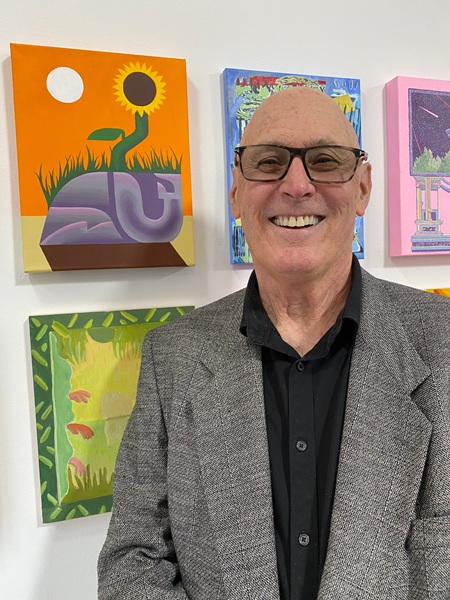
I was born in Lee Summit, Missouri, in 1948. (Yes, I’m a certified relic who strives to apply high expectations to my life each and every day.) To my knowledge, I never lived in Lee Summit, but my father was likely visiting a sibling (along with my pregnant birth mother) in nearby Independence, and I was likely impatient, wanting to join the fray and see what all the ruckus was about.
By that time, I was told by my stepmother, my 23-year-old father, just home from WWII with the Army Air Force, and my birth mother, the 17-year-old foster child of tavern owners, were often at odds, and I was soon taken in by my aunt and uncle and their two daughters, among various other related and unrelated babysitters in Kansas, Missouri, and other states along Dad’s southwestern truck routes.
Flashing forward, after growing up in a fractious family of eight, attending Graceland College for two years in Lamoni, Iowa, and snapping a tendon in my elbow while kicking around the Pirates’ minor league farm system for half a decade, I graduated from the University of Missouri at Kansas City in 1975–following a glorious year of coaching baseball at Central Methodist College in Fayette, Missouri, with my high school sports hero, Steve Phipps, then Central’s head baseball coach.
In 1976, while completing a teaching credential and Master’s degree in educational administration at the University of Missouri-Columbia, I served as a part-time K-8 art teacher at Renick School, in Renick, Missouri. In early 1977, however, Renick’s board of education not only fired their school administrator (principal and superintendent) but also, in their questionable wisdom, asked me to serve in this role.
During the next nine years, I served as a middle-level principal in four Missouri districts (Louisiana, Rolla, Jennings, and Ritenour), completing an Educational Specialist degree at UMC while at Louisiana and Rolla. At three of these institutions, I joined teachers in improving them toward later recognition from the USDOE as distinguished schools.
In 1985, in an effort to better understand the political assault on teachers and public education, I pursued a doctorate in curriculum and instruction, returning to UMC, taking a research associate position with the Center for Research on Social Behavior, and working with Dr. Thomas L. Good, a leading scholar on effective teaching, effective schools, and applying expectation communications in schools. After a brief, ill-fated stint as an area superintendent with the Kansas City School District—and learning valuable lessons about communicating expectations in urban settings—I completed my Ph.D.
I then took a tenure-track position as an assistant professor at the University of California, Riverside. While teaching ten (yes, 10) courses in curriculum, instruction, and educational administration, and serving in several UCR School of Education leadership positions, I conducted studies and published data-driven articles related to school and classroom organization, focusing largely on multi-grade classes—aka combination classes.
Despite well-above average teaching ratings in each of my ten assigned courses; off-the-chart leadership service to the School of Education, university committees, and school districts in California and beyond; a robust, though slow-to-emerge program of research; and overwhelming support from school colleagues, deans, external reviewers, and an ad hoc university committee, I fell short of earning tenure on a 3-4 final university-personnel-committee vote and a brief written comment that “Six of his studies are still pending review.” Ironically, within two years, each of those six studies were published and eventually cited by renowned scholar John Hattie in his seminal book, Visible Learning, on what makes a difference in promoting student achievement.
In 1998, I joined the Jurupa Unified School District in Riverside, California, as their Assistant Superintendent of Education Services. In that role, I supervised 22 school principals, 1000 teachers, and about 22,000 students. After six years in that position—during which JUSD’s education services department was recognized for two California School Board Golden Bell Awards for curriculum and instruction programs that created gains in student achievement—and the retirement of the superintendent who hired me, I chose to return to art teaching and school leadership positions at Rubidoux and Patriot High School, where I spent fourteen years and served as a department chair, data team leader, WASC coordinator, and girl’s softball coach.
During my career, I have received numerous awards, including Teacher of the Year, administrative and coaching honors, and state and national VOYA Financial Teacher Hero Awards. Besides presenting many workshops for educational groups, schools, and districts, I have served as a consultant for several state education agencies and departments.
My research studies, articles, and chapters have been published in several leading US and international journals and books, including Elementary School Journal, American Educational Research Journal, and Review of Educational Research.
Most proudly and important, after two solid and cordial strikes (foul balls?) just outside the lines, I have been married to my best friend and wonderful wife, Julie, for forty-two years and counting. We have raised four children (a son and three daughters) and assisted with two foster children, and we actively enjoy engaging in the upbringing of two awesome grandchildren, Rilo and Shel.